

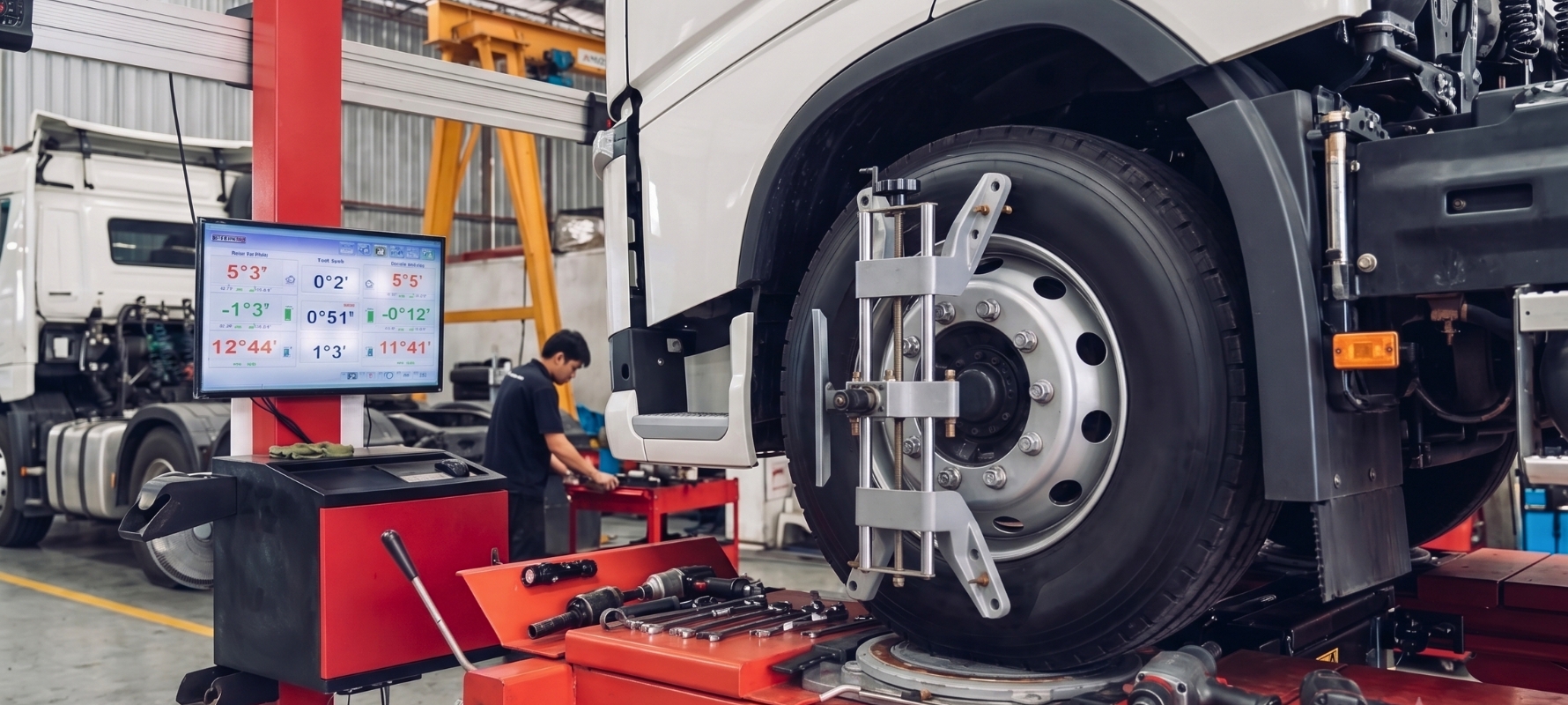
Semi truck wheel alignment is only as good as the measurement behind it. A tractor running Irvine’s freight and distribution routes carries multiple axles that all have to track true at once, and on a vehicle that long, a fraction of a degree at the rear axle becomes inches of scrub by the time the truck is rolling. Catching that takes a read precise enough to see it before the tires do.
At Alignment Express, we have aligned heavy-duty trucks across Southern California since 1995, and our Irvine facility at 16401 Construction Circle West completes most alignments the same day. Contact us to schedule service.
Why Multi-Axle Tracking Is a Precision Problem
A passenger car has two axles. A tractor has three or more, and each one has to sit square to the frame and parallel to the others, or the truck fights itself down the road. The angles that govern this are small. Toe, camber, caster, and thrust are measured in fractions of a degree, and the difference between in-spec and scrubbing tires often comes down to a margin too fine to judge by eye.
That is why the measurement method matters as much as the adjustment. We run every alignment on the Hunter HawkEye XL Heavy-Duty Alignment System, which reads all three axles at once through high-resolution digital imaging. Heavy-duty laser and digital systems resolve toe, camber, and caster to within roughly a tenth of a degree, the tolerance band where multi-axle corrections actually hold instead of drifting back out under the first load.
Why We Settle the Truck Before We Measure
A semi’s suspension is not static. The axle angles on a loaded tractor sit differently than they do on an empty one, and a reading taken on a truck whose suspension has not settled records a geometry the truck will not actually run in. Improper loading and unsettled suspension produce inaccurate measurements on exactly the systems most sensitive to it.
So before we record a single angle, we settle the chassis so the suspension sits where it will sit on the road. It is the difference between aligning the truck in front of us and aligning the truck as it actually operates, and it is the step a rushed alignment skips. A precise number measured under the wrong conditions is still the wrong number.
Correcting the Angles, and Making Them Hold
Measuring the misalignment is half the job. Correcting it on a multi-axle tractor means working the actual adjustment points rather than the wheels themselves. Steer-axle toe is set at the tie rod, and caster is corrected with shims between the axle and the spring, since the steer axle on most tractors has no built-in caster adjustment. Drive axles are squared to the frame and to each other through torque-rod adjustment, eccentric bushings, or shimming.
A correction only holds if the hardware holding the axle in place is sound. Worn spring-mount bushings, loose U-bolts, and tired torque rods let an axle creep back out of spec under acceleration and braking, which is why a truck can pull again weeks after an alignment that read clean on the rack.
We check the mounting hardware as part of the alignment, because tightening a number into a worn mount just schedules the next pull. When a bushing or fastener is the real culprit, we flag it before the truck leaves rather than after the tires tell on it.
The Precision Alignment Protects
The payoff for getting the read right shows up in the three places a fleet feels cost. Tires last their full life instead of scrubbing down early on a misalignment too slight to see. Fuel economy holds, because axles tracking true cut the rolling resistance that a dog-tracking rear axle drags against on every mile. And the driver works less, since a truck that tracks straight does not need constant steering correction over a long shift.
For trucks on Irvine’s high-cycle regional routes, feeding the distribution centers and running the congestion at the I-5 and I-405 merge, those costs compound fast. An alignment that holds is preventive maintenance that pays back load after load, not a one-time fix.
Serving Irvine and Orange County
Alignment Express operates from two California facilities: our Irvine location at 16401 Construction Circle West and our San Diego headquarters at 4748 Old Cliffs Road. The Irvine shop handles precision laser alignment across the full commercial range, along with the axle, frame, suspension, and steering work that an accurate alignment read often turns up, with same-day completion on most jobs.
Getting the measurement right is the whole job, because every correction after it depends on it. Visit the Irvine facility or contact us online to schedule service.
Frequently Asked Questions
How do I know my semi needs a wheel alignment?
The common signs are uneven or rapid tire wear, a pull to one side, a steering wheel that sits off-center on a straight road, and a trailer that tracks slightly sideways. On a multi-axle truck, rear-axle problems often show up in the tires before the driver feels anything wrong at the wheel. A check is also worth running after any hard impact or suspension work.
Why does a semi alignment cost more than a car alignment?
A semi alignment measures and adjusts angles across three or more axles rather than the two on a passenger car, and each axle has to be brought square to the frame and parallel to the others. The truck also has to be set up so its suspension sits in a representative position before measuring. More axles and a more involved setup mean more measurement and adjustment work than a car requires.
Does the trailer need to be aligned along with the tractor?
Yes, and checking them together is the most reliable way to confirm the full combination tracks straight. A trailer’s axles need to sit parallel to each other and square to the kingpin, or the trailer drags behind the tractor even when the tractor itself is in spec. A misaligned trailer wears its own tires and adds rolling resistance the tractor has to pull against.
How often should a semi running Orange County routes be aligned?
A check during routine preventive maintenance is the baseline, with the interval tightening for trucks on heavy loads or rough routes. An alignment is also worth running after suspension repairs, after a significant pothole or curb impact, and when fitting a new set of tires. High-cycle regional running puts alignment stress on a truck that lighter-duty intervals underestimate.
Can Alignment Express handle alignment and the repairs it uncovers in one visit?
Yes. The Irvine facility performs precision laser alignment along with the axle, suspension, steering, and frame work that an alignment read often turns up. When the read points to a bent axle or worn steering component, that work is sequenced so structural corrections come before the final alignment measurements. Contact the Irvine location to discuss what your truck needs.