

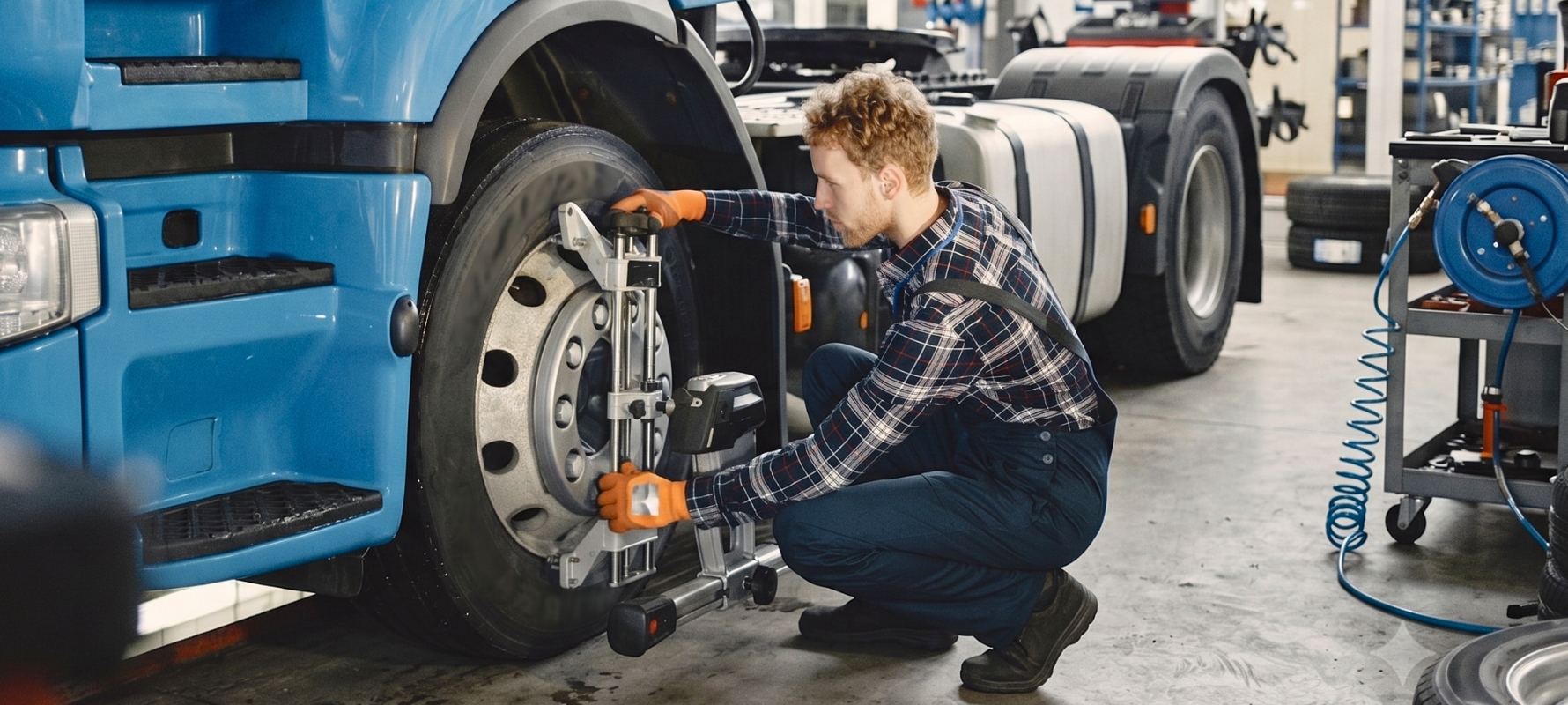
A truck alignment shop earns its keep by reading the whole vehicle, not by adjusting the steer axle and sending you on your way. On a commercial truck running San Diego freight, port, and construction routes, the wheels go out of true gradually, and the first evidence usually shows up in the tires long before the driver feels a pull. By then the question is not just how to set the angles back to spec. It is what knocked them out in the first place.
At Alignment Express, we have aligned heavy-duty trucks across Southern California since 1995, and our San Diego headquarters at 4748 Old Cliffs Road completes most alignments the same day. Contact us to schedule service.
What a Truck Alignment Measures
A commercial alignment is not a steer-axle adjustment scaled up from a passenger car. It reads four angles across multiple axles and compares each to the manufacturer’s spec. Toe sets how far the wheels point in or out and is the single biggest driver of tire wear. Camber is the vertical tilt of the wheel. Caster is the steering-axis angle that holds the truck tracking straight and controls how hard the driver works the wheel over a long shift.
Thrust angle is where a real commercial read separates from a quick one. It measures whether the rear axles push square to the frame, and on a tractor the TMC target for scrub and thrust is zero degrees. We run every alignment on the Hunter HawkEye XL Heavy-Duty Alignment System, which reads all three axles at once, so a rear axle pushing the truck off center shows up instead of getting masked by a front-toe adjustment.
Reading Tire Wear Back to Its Cause
Tire wear is a diagnostic record, not just a cost. Each pattern points to a specific angle, and reading it correctly is the difference between fixing the cause and replacing tires on a truck that will chew through the next set just as fast.
Feathering, where the tread feels sharp in one direction and smooth in the other, points to toe. Wear concentrated on one shoulder of the tire points to camber. The thrust-angle signature is the giveaway most shops miss: accelerated wear on the inside of one drive tire paired with the outside of the opposing drive tire, caused by drive axles that are not square to the frame.
A trailer that tracks slightly sideways down the road, called dog-tracking, points to drive or trailer axle misalignment rather than anything on the steer axle.
The point of the read is to stop the bleed. Catch toe wear early and a set of steer tires runs its full life. Miss it and the same misalignment scrubs the replacements down on the same schedule.
When Alignment Is the Fix, and When It Isn’t
Most alignment problems come down to toe and axle position, and an adjustment corrects them. Some do not, and a shop that treats every case as an adjustment sends trucks back out with the underlying problem intact.
A toe difference greater than half a degree across an axle is a flag that the housing is bent, not just out of adjustment, and no toe correction holds on a bent housing. A thrust angle paired with front-wheel setback points further down, toward frame damage, often from an impact that shifted one rail relative to the other. Worn kingpins are their own case: they create steering play that an alignment cannot remove and have to be replaced first.
This is why we inspect before we adjust. When the read points to a bent axle or a stressed frame, that structural work comes first, because alignment laid over either one drifts back out the moment the truck takes a load. San Diego routes feed the problem directly. The asphalt at the Otay Mesa port of entry alone takes cracks, potholes, and erosion from the thousands of vehicles crossing daily, and a single hard impact can knock a truck out of spec on the spot.
Serving San Diego’s Commercial Fleet
Alignment Express operates from two California facilities: our San Diego headquarters at 4748 Old Cliffs Road and our Irvine location at 16401 Construction Circle West. The San Diego shop handles precision laser alignment across the full commercial range, along with the axle, frame, suspension, and steering work that a thorough alignment read often turns up, with same-day completion on most jobs.
A clean alignment that holds saves fuel and a set of tires at a time, and it starts with finding the cause instead of resetting the symptom. Visit the San Diego facility or contact us online to schedule service.
Frequently Asked Questions
How do I know my truck needs an alignment?
The clearest signs are uneven tire wear, a pull to one side, a steering wheel that sits off-center on a straight road, and a trailer that tracks slightly sideways. Feathered or one-shoulder tire wear often shows up before the truck feels wrong to drive, which is why a wear check during routine service catches alignment problems early. Any truck that has taken a hard pothole or curb hit should be checked regardless of how it drives.
How often should a commercial truck be aligned?
Most commercial trucks benefit from an alignment check every 15,000 to 30,000 miles, with the interval tightening for trucks on rough routes or heavy loads. A check is also worth running after suspension work, after a significant impact, and when fitting a new set of tires. Trucks working port access roads and construction sites take on alignment stress that lighter highway intervals underestimate.
Why does a thrust angle reading require measuring the rear axles?
A thrust problem comes from the rear axles pushing off square to the frame, so it cannot be seen by measuring the steer axle alone. Reading the rear axles is the only way to tell whether the front wheels are actually straight or just cocked to compensate for a rear axle pushing the truck off center. That is why every alignment at our San Diego facility reads all axles, not just the front.
Can an alignment fix a truck that pulls after hitting a pothole?
Sometimes, and sometimes not. If the impact only knocked the angles out of adjustment, an alignment corrects it. If it bent an axle housing or stressed the frame, that structural damage has to be repaired first, because an alignment will not hold over a bent or shifted base. Our inspection identifies which case you are dealing with before any adjustment is made.
Does Alignment Express align trailers as well as tractors?
Yes. The San Diego facility aligns trailer axles along with tractor steer and drive axles, and checking them together is the most reliable way to confirm the full combination tracks straight. A misaligned trailer axle drags and wears trailer tires even when the tractor itself is in spec. Contact the San Diego location to discuss what your vehicle needs.